
Imported Product Information
What is the process for importing assembly line equipment?
Full Guide to Importing Assembly Line Equipment: End-to-End Procedures from Pre-Shipment Inspection to Domestic On-Site Delivery
GOOWELL specializes in machinery import and export, delivering full-chain compliance solutions for assembly line equipment import covering qualification review all the way through to on-site final delivery.
A complete assembly line integrates numerically-controlled machine tools, machining centers, conveying systems, testing equipment and more, often consisting of dozens or even hundreds of individual machines. These machines are shipped from Germany, Japan, South Korea and other countries to factories across China, navigating multiple critical procedures including HS code classification, pre-shipment inspection, import licensing, customs valuation and physical customs inspection.
Misclassification under an incorrect HS code may lead to back tax payments plus fines exceeding RMB 100,000. Shipping used equipment without completing pre-shipment inspection results in non-clearable cargo upon arrival, with port detention fees running upwards of RMB 1,000 per day.
The biggest challenges of assembly line import lie not in international transportation, but in adequate compliance preparation prior to shipment.
01 Why Importing Assembly Line Equipment Is Complicated
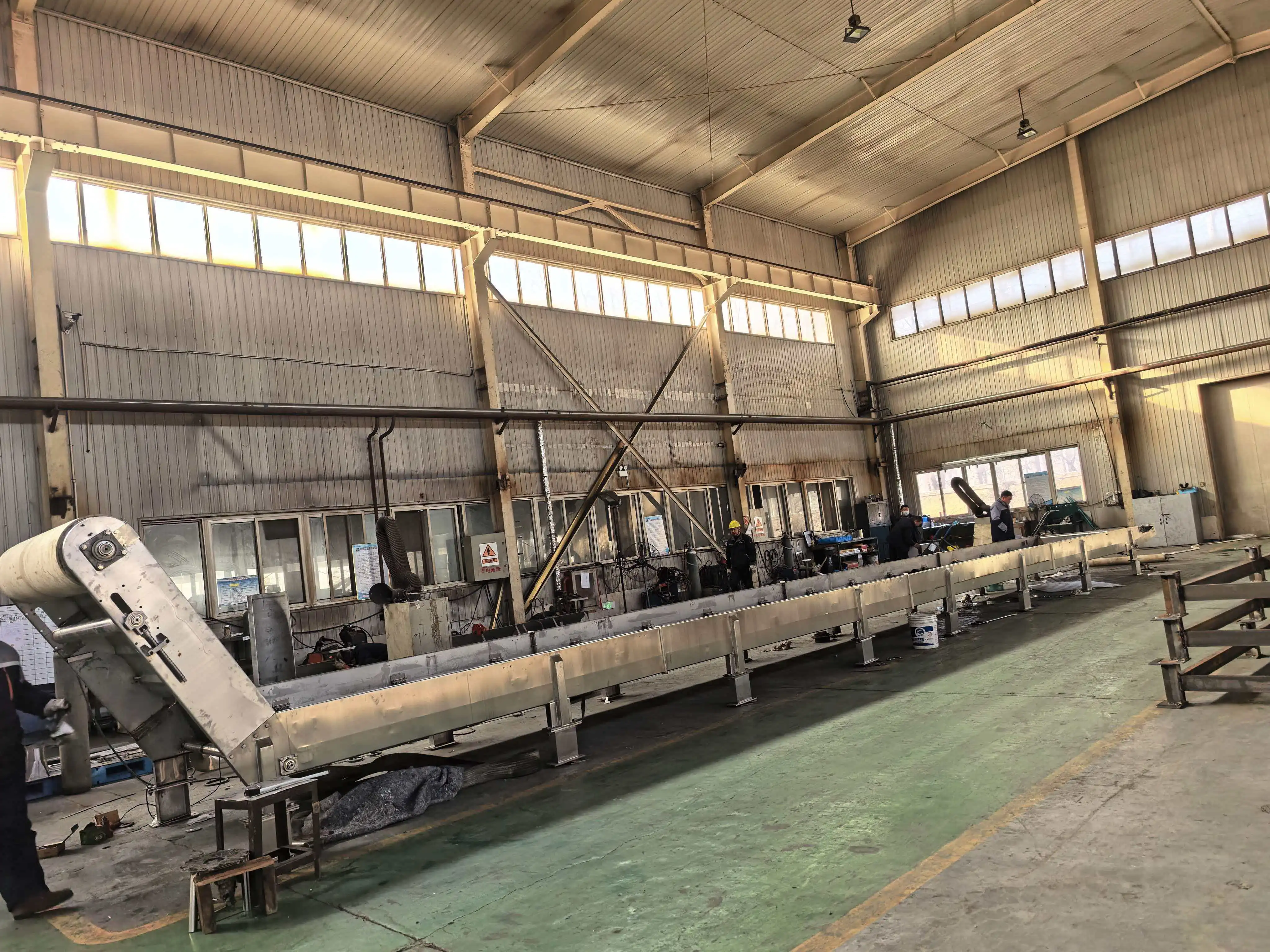
Caption: A full CNC machining assembly line incorporates cutting, grinding, conveying and testing equipment with distinct HS codes (real project photo from GOOWELL)
An assembly line is not a standalone machine but an entire integrated production system. A typical CNC machining line may cover cutting machine tools (HS Codes 8458–8459), grinding and polishing machinery (8460), conveying systems (8428), industrial robots (8479), inspection equipment (9031) and other categories. Each category carries unique HS codes, tariff rates and customs control requirements.
Challenge 1: HS Code Classification
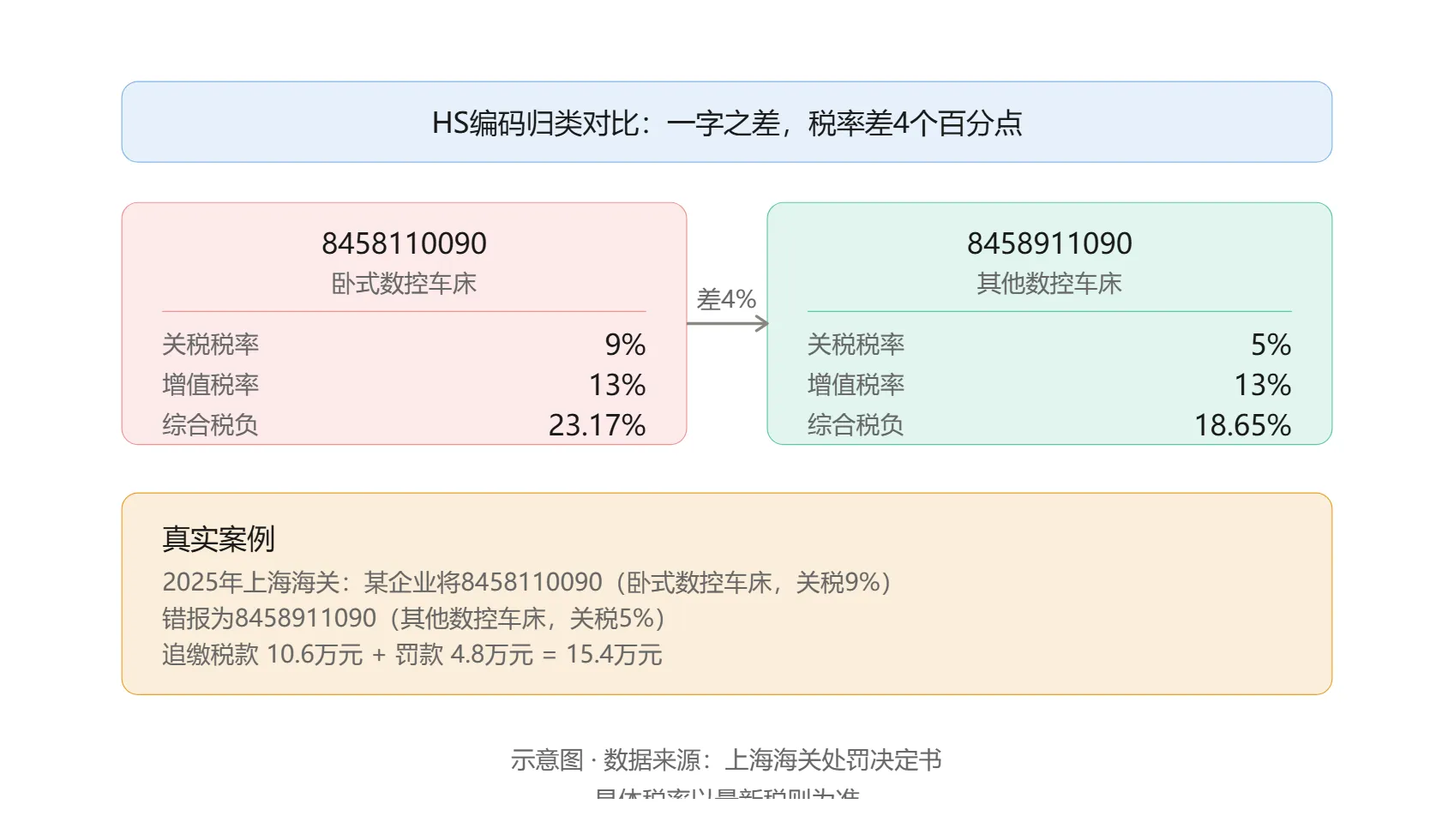
Even for seemingly identical "CNC machine tools", HS Code 8458110090 (horizontal CNC lathe) attracts a 9% tariff, while HS Code 8458911090 (other CNC lathes) incurs a 5% tariff. A tiny difference in code wording creates a 4-percentage-point tariff gap. In 2025, Shanghai Customs penalized an enterprise for misdeclaring 8458110090 as 8458911090, ordering RMB 106,000 in back taxes plus an additional fine of RMB 48,000.
Caption: Similar equipment under different HS codes may carry tariff differences of 4 percentage points; misclassification entails heavy costs (schematic diagram; applicable tariff rates subject to the latest Customs Tariff Schedule)
Challenge 2: Regulatory Differences Between New and Used Equipment
Import workflows are far simpler for brand-new equipment, which mainly requires accurate HS coding and tariff declaration. Used/second-hand equipment entails far more red tape: mandatory CCIC pre-shipment inspection, possible application for Automatic Import Licenses (O License) or Licenses for Key Used Mechanical and Electrical Products, stricter customs valuation rules, and mandatory domestic destination inspection for certain equipment before commissioning.
Challenge 3: Packaging & Transportation
Assembly line equipment often features oversized dimensions and overweight tonnage; precision units are sensitive to vibration and humidity. Packaging must be engineered for shock resistance and moisture proofing. Over-dimensional cargo calls for flat rack containers or open-top containers, and overweight/oversized shipments require road oversize transport permits.
Nearly all import pitfalls stem from inadequate preparation before shipment.
02 Qualification & Document Preparation Prior to Import
Three core pre-shipment tasks govern assembly line import: confirming HS codes and customs control conditions, finishing pre-shipment inspection, and securing import permits.
HS classification is the starting point. The 10-digit HS code must be determined according to equipment brand, model, function and intended usage. After classification, importers confirm applicable tariffs, VAT rates and regulatory controls, including requirements for O Licenses, CCC certification, and whether the used machinery falls on the Prohibited Import List for Used Mechanical and Electrical Products. Classification confirmation is strongly recommended before signing purchase contracts to avoid unimportable goods post-purchase.
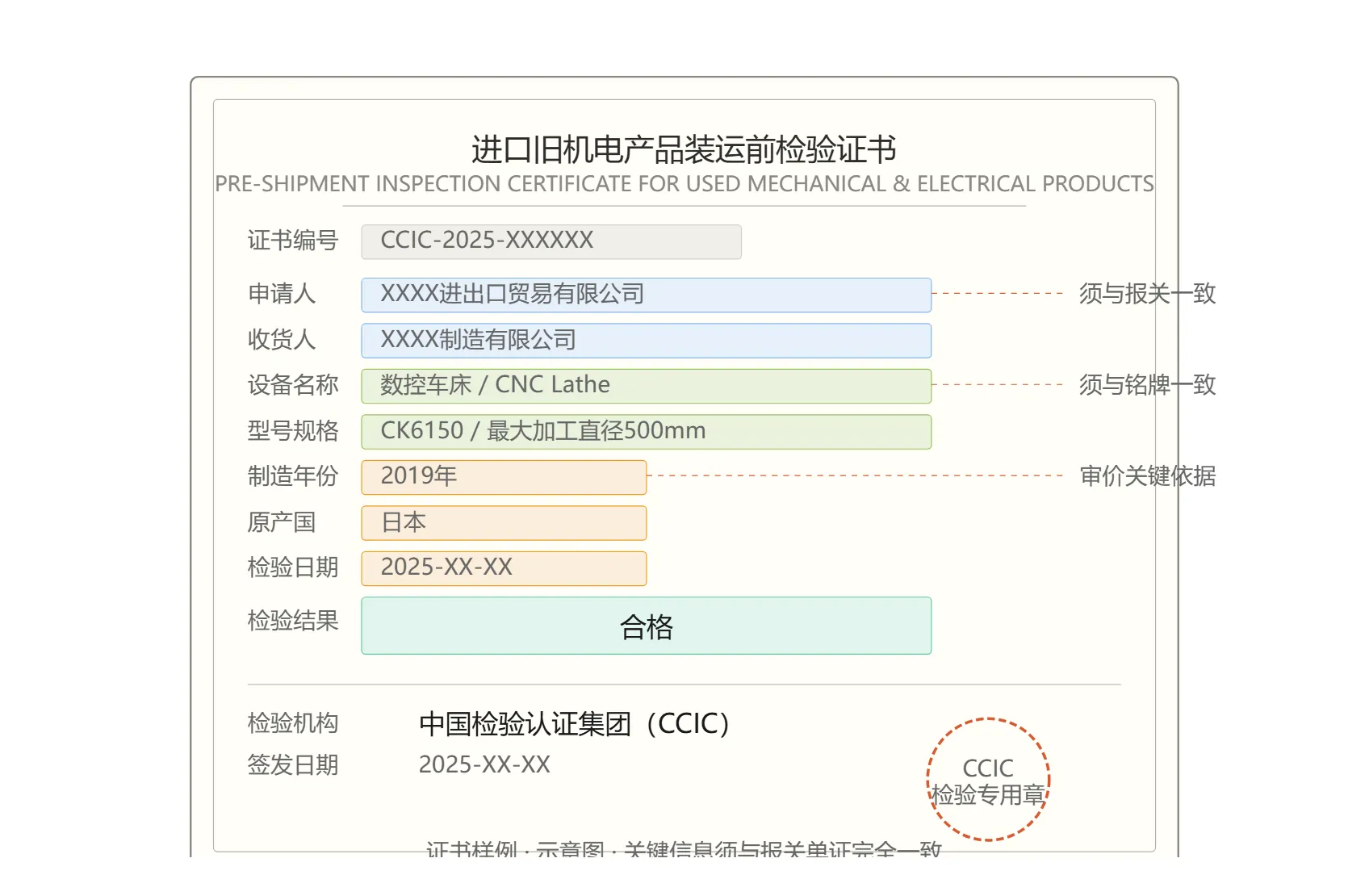
Pre-Shipment Inspection (PSI) by CCIC is compulsory for all used equipment. China Certification & Inspection Group (CCIC) executes inspections in the country of origin or Hong Kong, verifying equipment safety, environmental compliance, and consistency between nameplate details and declared information. Inspection takes 5–10 working days, costing 0.3%–0.8% of the cargo value. No customs clearance is permitted without this certificate. New equipment generally waives CCIC PSI requirements.
Caption: Used equipment import requires a valid CCIC Pre-Shipment Inspection Certificate; all critical details must match perfectly across customs documents and equipment nameplates
Two types of import licenses apply:
Automatic Import License (O License): Mandatory for most used electromechanical equipment. Applications are submitted via the Single Window Platform of the Ministry of Commerce, with approval taking 5–7 working days.
License for Key Used Mechanical and Electrical Products: Required for heavy-duty machine tools, construction machinery and specified equipment. Approval takes roughly 21 working days and demands supplementary technical documentation and usage statements.
Most new equipment does not require import licenses, though high-tech or national security-related machinery still needs permit approval.
Mandatory baseline documents include sales contracts, commercial invoices (used equipment invoices must clearly state "second-hand", alongside original value, depreciation rate and service life), packing lists, ocean bills of lading, and certificates of origin (for preferential tariff eligibility). Additional paperwork for used equipment includes nameplate photos, technical manuals, original commercial invoices or third-party appraisal reports to support customs valuation. Wooden packaging must display valid IPPC marks and fumigation certificates.
Thorough pre-work streamlines subsequent clearance; insufficient pre-prep triggers endless corrective measures and delays.
03 End-to-End Import Workflow for Assembly Line Equipment
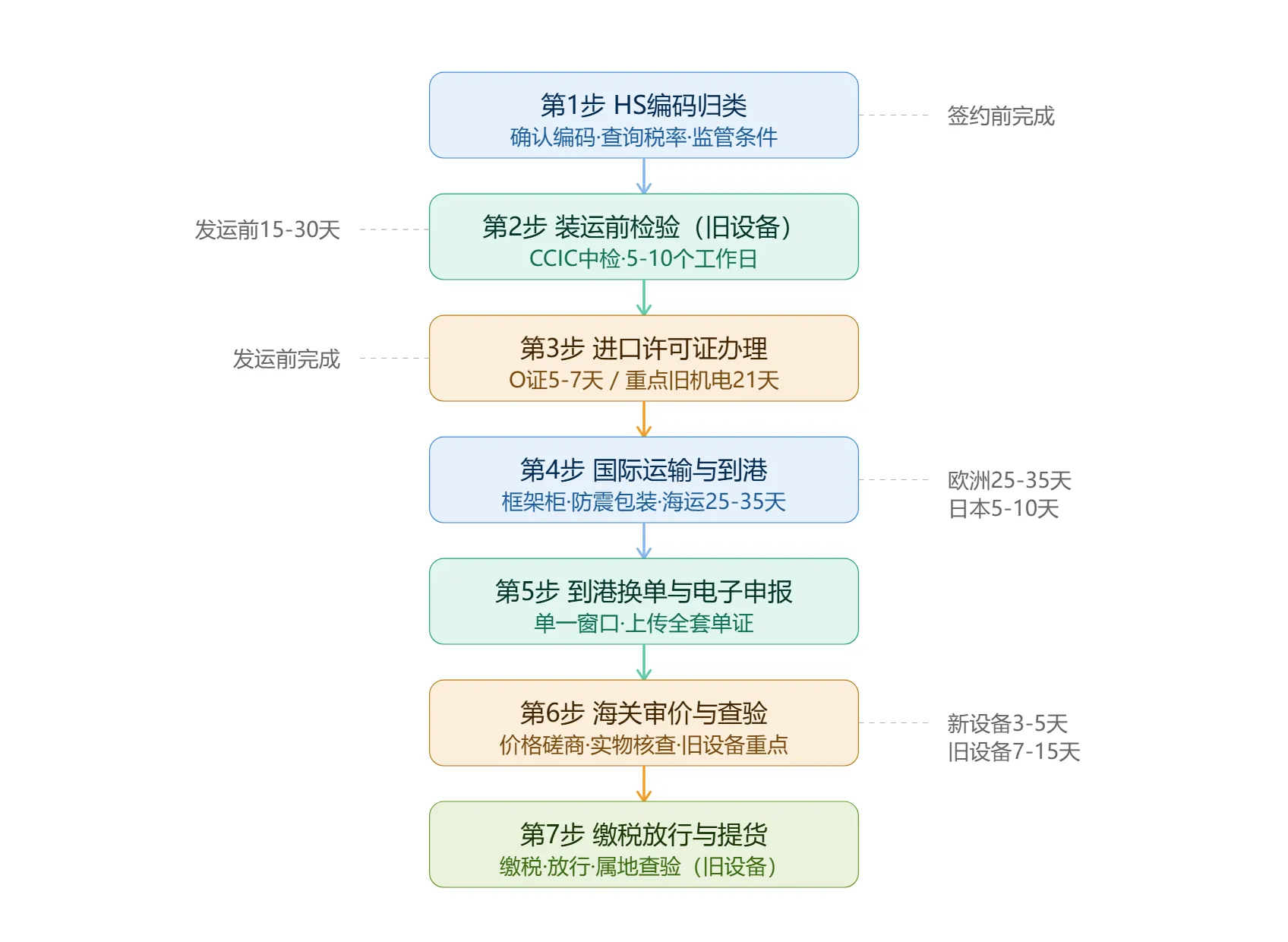
Caption: Step-by-step import workflow for assembly line equipment from HS classification confirmation to domestic destination inspection with clear timelines
Step 1: HS Coding & Customs Control Verification
Classify each machine against HS codes one by one, confirming tariff rates, regulatory controls and special permit obligations. For new equipment, prioritize CCC certification checks; for used equipment, confirm exclusion from the Prohibited Import Catalogue for Used Mechanical and Electrical Products.
Step 2: Pre-Shipment Inspection (Exclusive to Used Equipment)
Engage CCIC 15–30 days before scheduled shipment for inspections covering safety protection, environmental compliance and nameplate matching. Passing inspection yields the Certificate of Pre-Shipment Inspection for Imported Used Mechanical and Electrical Products.
Step 3: Import License Application
For used equipment requiring O Licenses, submit CCIC pre-review results, contracts, invoices and supporting materials via the Single Window portal. Key used machinery applications require extra technical paperwork and longer lead times. All licenses should be secured before cargo departs overseas.
Step 4: International Shipping & Cargo Arrival
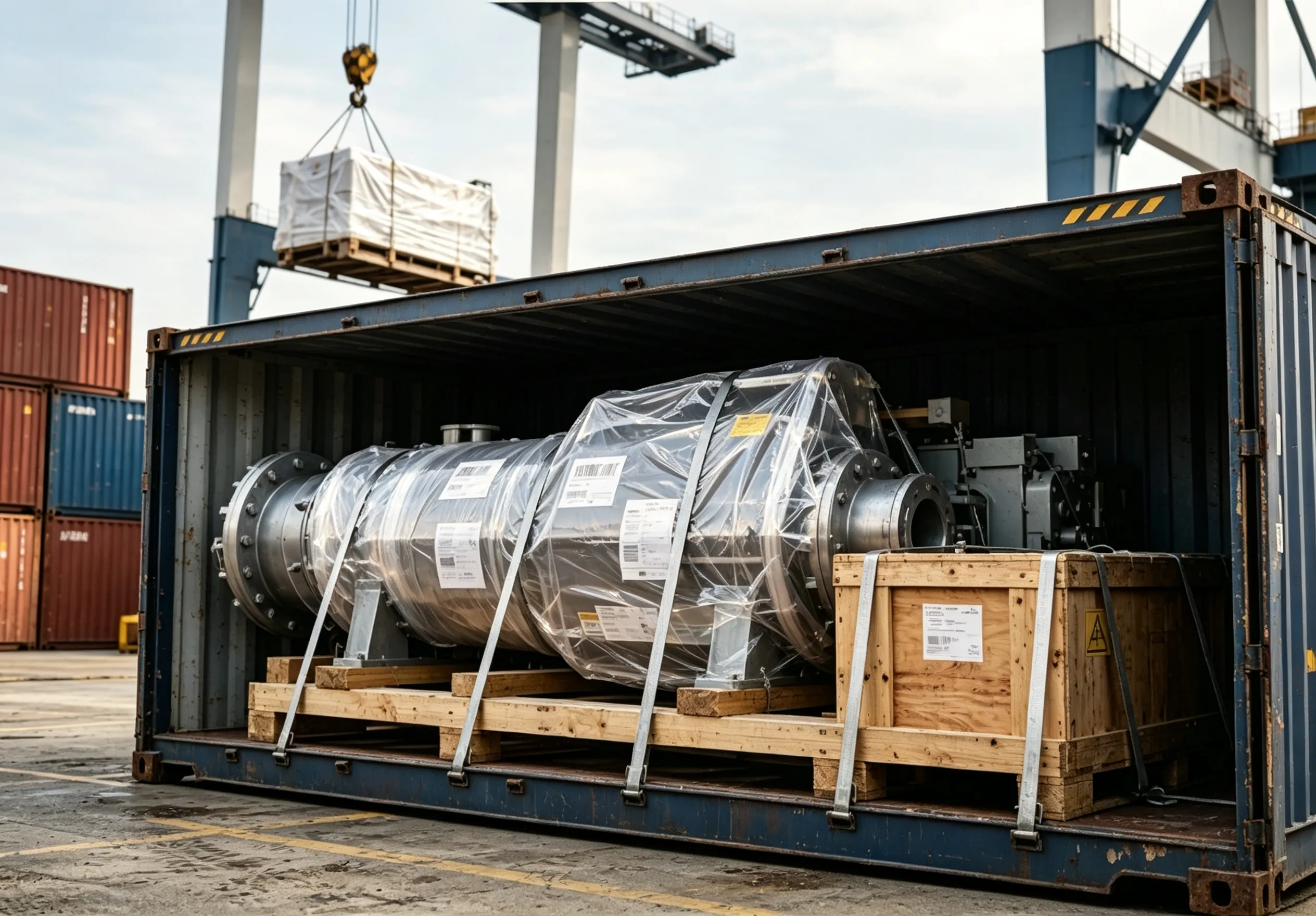
Select container types based on equipment dimensions and weight:
20GP: small-to-medium machinery
40HQ: medium-sized equipment
Flat rack/open-top containers: extra-wide/extra-tall oversized cargo
Precision machinery is packed with vacuum wrapping plus desiccants for humidity control; heavy equipment is secured inside containers with wooden bracing and lashing straps. Ocean transit takes 25–35 days from Europe to China, and 5–10 days from Japan to China.
Caption: Oversized cargo shipped via flat rack containers; precision machinery requires shockproof, moisture-resistant packaging (real project photo from GOOWELL)
Step 5: Terminal Document Exchange & Electronic Customs Declaration
Exchange bills of lading for delivery orders with the shipping carrier, then submit customs and inspection declaration data plus full document packages through the International Trade Single Window. Declared elements include brand, model, manufacturing year, function, application and quantity; used shipments must be marked "used mechanical and electrical goods".
Step 6: Customs Valuation & Physical Inspection
Customs verifies the reasonableness of declared transaction value. Used equipment undergoes rigorous valuation audits. If the declared price falls drastically below market benchmarks, Customs initiates price negotiation, requiring supporting evidence such as original invoices and foreign exchange payment vouchers. Physical inspection cross-checks physical goods against declarations, focusing on model, production year and nameplate consistency. For used machinery, inspectors also check for oil leaks and potential safety hazards.
Step 7: Tax Payment, Customs Release & Cargo Pickup
Customs issues tax notifications post-valuation approval. Goods are released after importers settle applicable customs duties and VAT. Certain categories of used equipment require domestic destination inspection: cargo is transported to the designated domestic site, where local Customs conducts unpacked examinations and even power-on testing. Goods can only enter formal production after passing safety and environmental compliance verification.
Clearance Lead Time Reference
New equipment with no inspection: 3–5 working days; with inspection: 5–7 working days
Used equipment: stricter valuation and inspection extend total clearance to 7–15 working days
Every step has fixed timelines; delays in one phase push back all subsequent procedures.
04 Common Questions & Risk Avoidance Guide
Q: What are the import tariff rates for assembly line equipment?
A: Tariffs are determined by equipment type and corresponding HS code. CNC lathes attract 5%–9% duties, machining centers 5%–7%, industrial robots 0%–5%, and testing equipment 5%–10%. A uniform 13% VAT applies to all imports. Final rates are subject to the latest official Customs Tariff Schedule tied to each HS code.
Q: What core differences exist between importing new versus used equipment?
A: Used equipment mandates CCIC pre-shipment inspection plus O Licenses/key used machinery permits, faces far stricter customs valuation, and may require domestic destination inspection. New equipment generally skips these procedures, enabling faster clearance, though CCC certification may still apply to certain models.
Q: What consequences arise from incorrect HS classification?
A: Minor cases require amendment declarations and supplementary tariff payments with nominal amendment fees. Severe misclassification is deemed false declaration, triggering back payment of owed taxes plus fines equivalent to 30%–50% of underpaid duties. Serious violations are referred to Customs Anti-Smuggling departments. For ambiguous coding scenarios, apply to Customs in advance for official pre-classification rulings.
Q: Can CCIC inspection be completed after cargo arrives at port if omitted pre-shipment?
A: No retroactive inspection is allowed. CCIC pre-shipment inspection must be completed in the exporting country or Hong Kong before cargo departs. The only remedy is returning goods to the origin country or transshipping to Hong Kong for inspection prior to re-import, incurring substantial round-trip freight and schedule losses.
Critical Reminder
Nameplate information (brand, model, production year, country of origin) on used equipment must match CCIC certificates and customs documents word-for-word. Information discrepancy ranks top among reasons for forced cargo return.
05 Import Expertise from GOOWELL International Logistics
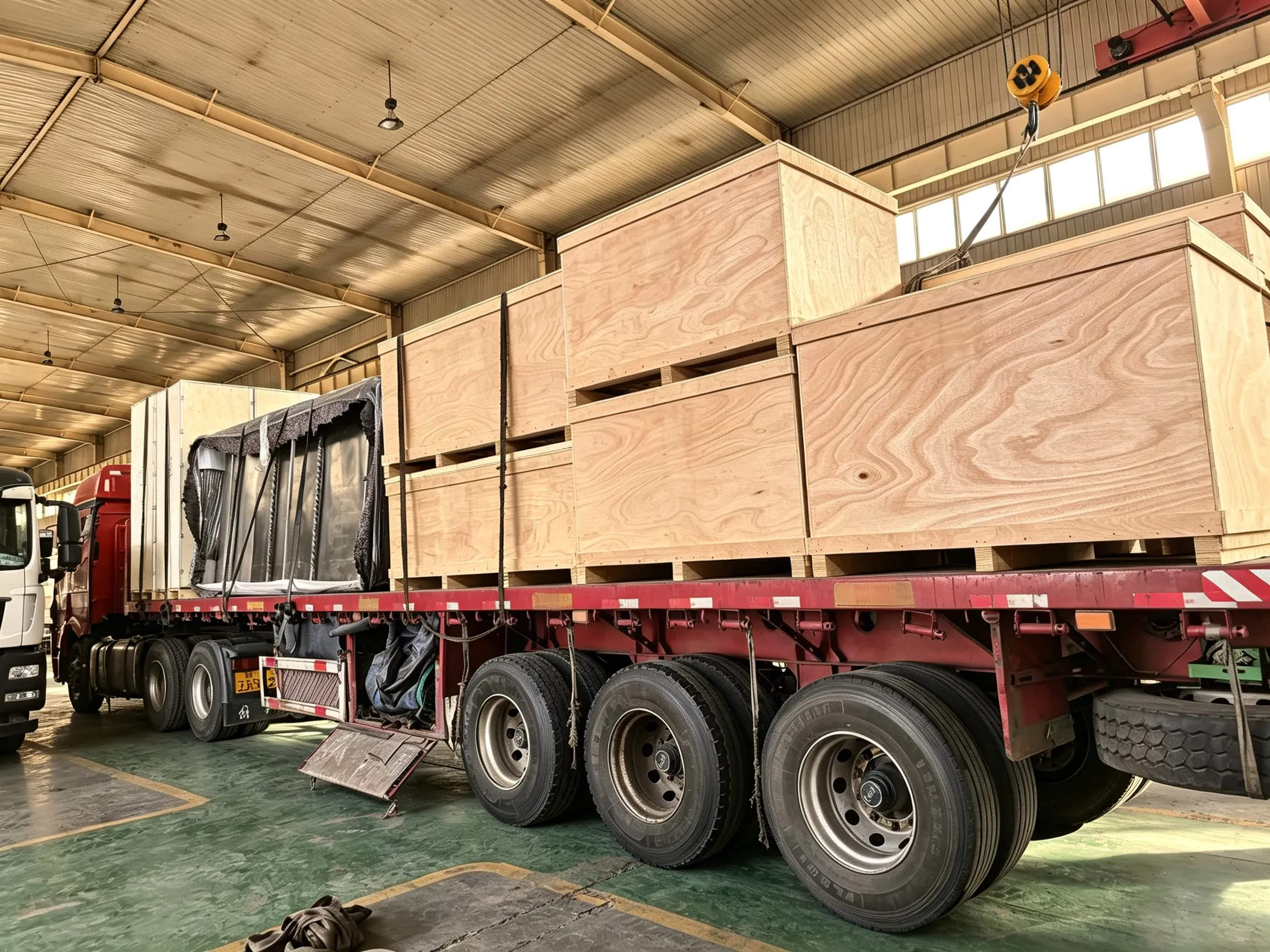
Caption: Door-to-door service covering full logistics from overseas factory pickup to domestic plant delivery (real project photo from GOOWELL)
We boast extensive hands-on experience in machinery import and export, supporting imports of CNC machine tools, machining centers, complete production lines, precision instruments and more.
End-to-end project coordination defines successful assembly line import. An integrated line may source machinery across multiple countries and vendors with staggered arrival times, varied HS codes and mixed new/used units. GOOWELL devises customized import roadmaps for each production line, including unified HS classification, phased CCIC scheduling, coordinated port arrival timelines and consolidated customs filings. This avoids excessive warehousing and detention fees caused by scattered shipments.
For packaging and transportation, precision equipment receives customized shockproof vacuum moisture-proof packaging; oversized heavy machinery uses tailor-made flat rack container solutions, with overland oversize permits secured ahead of domestic haulage. Mainstream ocean carriers including COSCO Shipping and Maersk are our long-term partners. Our overseas agency network in Europe, Japan, South Korea and major equipment-exporting regions enables complete door-to-door logistics covering overseas factory collection through domestic factory handover.
Our customs brokerage team fully understands valuation audit criteria for industrial machinery and compiles supporting valuation materials in advance to minimize price negotiation risks with Customs.
Equipment import management begins at contract signing rather than merely cargo portage.
Key Official Term Glossary (Standard Customs Terminology)
HS Code: Harmonized Commodity Description and Coding System Code
Pre-Shipment Inspection (PSI): Certification & Inspection Group
Automatic Import License (O License): 自动进口许可证(O 证)
License for Key Used Mechanical and Electrical Products: 重点旧机电进口许可证
Customs Valuation: 海关审价
Destination Inspection / Domestic On-Site Inspection: 属地查验
CCC Certification: China Compulsory Certification 中国强制性产品认证
IPPC Mark: International Plant Protection Convention Mark 木质包装 IPPC 标识
Single Window: International Trade Single Window 国际贸易单一窗口
Used Mechanical and Electrical Products: 旧机电产品
Prohibited Import Catalogue for Used Mechanical and Electrical Products: 禁止进口旧机电产品目录
Flat Rack Container / Open-Top Container: 框架柜 / 开顶柜
Full Guide to Importing Assembly Line Equipment: End-to-End Procedures from Pre-Shipment Inspection to Domestic On-Site Delivery
GOOWELL specializes in machinery import and export, delivering full-chain compliance solutions for assembly line equipment import covering qualification review all the way through to on-site final delivery.
A complete assembly line integrates numerically-controlled machine tools, machining centers, conveying systems, testing equipment and more, often consisting of dozens or even hundreds of individual machines. These machines are shipped from Germany, Japan, South Korea and other countries to factories across China, navigating multiple critical procedures including HS code classification, pre-shipment inspection, import licensing, customs valuation and physical customs inspection.
Misclassification under an incorrect HS code may lead to back tax payments plus fines exceeding RMB 100,000. Shipping used equipment without completing pre-shipment inspection results in non-clearable cargo upon arrival, with port detention fees running upwards of RMB 1,000 per day.
The biggest challenges of assembly line import lie not in international transportation, but in adequate compliance preparation prior to shipment.
01 Why Importing Assembly Line Equipment Is Complicated
Caption: A full CNC machining assembly line incorporates cutting, grinding, conveying and testing equipment with distinct HS codes (real project photo from GOOWELL)
An assembly line is not a standalone machine but an entire integrated production system. A typical CNC machining line may cover cutting machine tools (HS Codes 8458–8459), grinding and polishing machinery (8460), conveying systems (8428), industrial robots (8479), inspection equipment (9031) and other categories. Each category carries unique HS codes, tariff rates and customs control requirements.
Challenge 1: HS Code Classification
Even for seemingly identical "CNC machine tools", HS Code 8458110090 (horizontal CNC lathe) attracts a 9% tariff, while HS Code 8458911090 (other CNC lathes) incurs a 5% tariff. A tiny difference in code wording creates a 4-percentage-point tariff gap. In 2025, Shanghai Customs penalized an enterprise for misdeclaring 8458110090 as 8458911090, ordering RMB 106,000 in back taxes plus an additional fine of RMB 48,000.
Caption: Similar equipment under different HS codes may carry tariff differences of 4 percentage points; misclassification entails heavy costs (schematic diagram; applicable tariff rates subject to the latest Customs Tariff Schedule)
Challenge 2: Regulatory Differences Between New and Used Equipment
Import workflows are far simpler for brand-new equipment, which mainly requires accurate HS coding and tariff declaration. Used/second-hand equipment entails far more red tape: mandatory CCIC pre-shipment inspection, possible application for Automatic Import Licenses (O License) or Licenses for Key Used Mechanical and Electrical Products, stricter customs valuation rules, and mandatory domestic destination inspection for certain equipment before commissioning.
Challenge 3: Packaging & Transportation
Assembly line equipment often features oversized dimensions and overweight tonnage; precision units are sensitive to vibration and humidity. Packaging must be engineered for shock resistance and moisture proofing. Over-dimensional cargo calls for flat rack containers or open-top containers, and overweight/oversized shipments require road oversize transport permits.
Nearly all import pitfalls stem from inadequate preparation before shipment.
02 Qualification & Document Preparation Prior to Import
Three core pre-shipment tasks govern assembly line import: confirming HS codes and customs control conditions, finishing pre-shipment inspection, and securing import permits.
HS classification is the starting point. The 10-digit HS code must be determined according to equipment brand, model, function and intended usage. After classification, importers confirm applicable tariffs, VAT rates and regulatory controls, including requirements for O Licenses, CCC certification, and whether the used machinery falls on the Prohibited Import List for Used Mechanical and Electrical Products. Classification confirmation is strongly recommended before signing purchase contracts to avoid unimportable goods post-purchase.
Pre-Shipment Inspection (PSI) by CCIC is compulsory for all used equipment. China Certification & Inspection Group (CCIC) executes inspections in the country of origin or Hong Kong, verifying equipment safety, environmental compliance, and consistency between nameplate details and declared information. Inspection takes 5–10 working days, costing 0.3%–0.8% of the cargo value. No customs clearance is permitted without this certificate. New equipment generally waives CCIC PSI requirements.
Caption: Used equipment import requires a valid CCIC Pre-Shipment Inspection Certificate; all critical details must match perfectly across customs documents and equipment nameplates
Two types of import licenses apply:
Automatic Import License (O License): Mandatory for most used electromechanical equipment. Applications are submitted via the Single Window Platform of the Ministry of Commerce, with approval taking 5–7 working days.
License for Key Used Mechanical and Electrical Products: Required for heavy-duty machine tools, construction machinery and specified equipment. Approval takes roughly 21 working days and demands supplementary technical documentation and usage statements.
Most new equipment does not require import licenses, though high-tech or national security-related machinery still needs permit approval.
Mandatory baseline documents include sales contracts, commercial invoices (used equipment invoices must clearly state "second-hand", alongside original value, depreciation rate and service life), packing lists, ocean bills of lading, and certificates of origin (for preferential tariff eligibility). Additional paperwork for used equipment includes nameplate photos, technical manuals, original commercial invoices or third-party appraisal reports to support customs valuation. Wooden packaging must display valid IPPC marks and fumigation certificates.
Thorough pre-work streamlines subsequent clearance; insufficient pre-prep triggers endless corrective measures and delays.
03 End-to-End Import Workflow for Assembly Line Equipment
Caption: Step-by-step import workflow for assembly line equipment from HS classification confirmation to domestic destination inspection with clear timelines
Step 1: HS Coding & Customs Control Verification
Classify each machine against HS codes one by one, confirming tariff rates, regulatory controls and special permit obligations. For new equipment, prioritize CCC certification checks; for used equipment, confirm exclusion from the Prohibited Import Catalogue for Used Mechanical and Electrical Products.
Step 2: Pre-Shipment Inspection (Exclusive to Used Equipment)
Engage CCIC 15–30 days before scheduled shipment for inspections covering safety protection, environmental compliance and nameplate matching. Passing inspection yields the Certificate of Pre-Shipment Inspection for Imported Used Mechanical and Electrical Products.
Step 3: Import License Application
For used equipment requiring O Licenses, submit CCIC pre-review results, contracts, invoices and supporting materials via the Single Window portal. Key used machinery applications require extra technical paperwork and longer lead times. All licenses should be secured before cargo departs overseas.
Step 4: International Shipping & Cargo Arrival
Select container types based on equipment dimensions and weight:
20GP: small-to-medium machinery
40HQ: medium-sized equipment
Flat rack/open-top containers: extra-wide/extra-tall oversized cargo
Precision machinery is packed with vacuum wrapping plus desiccants for humidity control; heavy equipment is secured inside containers with wooden bracing and lashing straps. Ocean transit takes 25–35 days from Europe to China, and 5–10 days from Japan to China.
Caption: Oversized cargo shipped via flat rack containers; precision machinery requires shockproof, moisture-resistant packaging (real project photo from GOOWELL)
Step 5: Terminal Document Exchange & Electronic Customs Declaration
Exchange bills of lading for delivery orders with the shipping carrier, then submit customs and inspection declaration data plus full document packages through the International Trade Single Window. Declared elements include brand, model, manufacturing year, function, application and quantity; used shipments must be marked "used mechanical and electrical goods".
Step 6: Customs Valuation & Physical Inspection
Customs verifies the reasonableness of declared transaction value. Used equipment undergoes rigorous valuation audits. If the declared price falls drastically below market benchmarks, Customs initiates price negotiation, requiring supporting evidence such as original invoices and foreign exchange payment vouchers. Physical inspection cross-checks physical goods against declarations, focusing on model, production year and nameplate consistency. For used machinery, inspectors also check for oil leaks and potential safety hazards.
Step 7: Tax Payment, Customs Release & Cargo Pickup
Customs issues tax notifications post-valuation approval. Goods are released after importers settle applicable customs duties and VAT. Certain categories of used equipment require domestic destination inspection: cargo is transported to the designated domestic site, where local Customs conducts unpacked examinations and even power-on testing. Goods can only enter formal production after passing safety and environmental compliance verification.
Clearance Lead Time Reference
New equipment with no inspection: 3–5 working days; with inspection: 5–7 working days
Used equipment: stricter valuation and inspection extend total clearance to 7–15 working days
Every step has fixed timelines; delays in one phase push back all subsequent procedures.
04 Common Questions & Risk Avoidance Guide
Q: What are the import tariff rates for assembly line equipment?
A: Tariffs are determined by equipment type and corresponding HS code. CNC lathes attract 5%–9% duties, machining centers 5%–7%, industrial robots 0%–5%, and testing equipment 5%–10%. A uniform 13% VAT applies to all imports. Final rates are subject to the latest official Customs Tariff Schedule tied to each HS code.
Q: What core differences exist between importing new versus used equipment?
A: Used equipment mandates CCIC pre-shipment inspection plus O Licenses/key used machinery permits, faces far stricter customs valuation, and may require domestic destination inspection. New equipment generally skips these procedures, enabling faster clearance, though CCC certification may still apply to certain models.
Q: What consequences arise from incorrect HS classification?
A: Minor cases require amendment declarations and supplementary tariff payments with nominal amendment fees. Severe misclassification is deemed false declaration, triggering back payment of owed taxes plus fines equivalent to 30%–50% of underpaid duties. Serious violations are referred to Customs Anti-Smuggling departments. For ambiguous coding scenarios, apply to Customs in advance for official pre-classification rulings.
Q: Can CCIC inspection be completed after cargo arrives at port if omitted pre-shipment?
A: No retroactive inspection is allowed. CCIC pre-shipment inspection must be completed in the exporting country or Hong Kong before cargo departs. The only remedy is returning goods to the origin country or transshipping to Hong Kong for inspection prior to re-import, incurring substantial round-trip freight and schedule losses.
Critical Reminder
Nameplate information (brand, model, production year, country of origin) on used equipment must match CCIC certificates and customs documents word-for-word. Information discrepancy ranks top among reasons for forced cargo return.
05 Import Expertise from GOOWELL International Logistics
Caption: Door-to-door service covering full logistics from overseas factory pickup to domestic plant delivery (real project photo from GOOWELL)
We boast extensive hands-on experience in machinery import and export, supporting imports of CNC machine tools, machining centers, complete production lines, precision instruments and more.
End-to-end project coordination defines successful assembly line import. An integrated line may source machinery across multiple countries and vendors with staggered arrival times, varied HS codes and mixed new/used units. GOOWELL devises customized import roadmaps for each production line, including unified HS classification, phased CCIC scheduling, coordinated port arrival timelines and consolidated customs filings. This avoids excessive warehousing and detention fees caused by scattered shipments.
For packaging and transportation, precision equipment receives customized shockproof vacuum moisture-proof packaging; oversized heavy machinery uses tailor-made flat rack container solutions, with overland oversize permits secured ahead of domestic haulage. Mainstream ocean carriers including COSCO Shipping and Maersk are our long-term partners. Our overseas agency network in Europe, Japan, South Korea and major equipment-exporting regions enables complete door-to-door logistics covering overseas factory collection through domestic factory handover.
Our customs brokerage team fully understands valuation audit criteria for industrial machinery and compiles supporting valuation materials in advance to minimize price negotiation risks with Customs.
Equipment import management begins at contract signing rather than merely cargo portage.
Key Official Term Glossary (Standard Customs Terminology)
HS Code: Harmonized Commodity Description and Coding System Code
Pre-Shipment Inspection (PSI): Certification & Inspection Group
Automatic Import License (O License): 自动进口许可证(O 证)
License for Key Used Mechanical and Electrical Products: 重点旧机电进口许可证
Customs Valuation: 海关审价
Destination Inspection / Domestic On-Site Inspection: 属地查验
CCC Certification: China Compulsory Certification 中国强制性产品认证
IPPC Mark: International Plant Protection Convention Mark 木质包装 IPPC 标识
Single Window: International Trade Single Window 国际贸易单一窗口
Used Mechanical and Electrical Products: 旧机电产品
Prohibited Import Catalogue for Used Mechanical and Electrical Products: 禁止进口旧机电产品目录
Flat Rack Container / Open-Top Container: 框架柜 / 开顶柜
ABOUT GOOWELL
Ningbo Goowell International Logistics Co., Ltd. has always adhered to the vision of providing customers with safe and convenient services since its establishment, and has established cooperation with many foreign companies, central state-owned enterprises, listed companies and well-known domestic enterprises.