
Imported Product Information
Export of ultra-wide and ultra-high equipment in bare package
Guide to Bare Shipment of Over Width and Over Height Equipment
How to Conduct Bare Shipment of Over Width & Over Height Equipment
Flat Rack Selection, Lashing Reinforcement and Full Link Operation Key Points
GOOWELL focuses on the import and export of mechanical equipment, providing full link bare shipment services for over width and over height equipment covering scheme design to delivery at destination factories.
Taking a 4.8 meter high equipment as an example: transporting it from domestic factories to factories on Batam Island, Indonesia involves multiple links including dimension measurement, transportation mode selection, lashing reinforcement, oversize transportation permits, port loading and unloading, ocean shipping monitoring, customs clearance and delivery at destination ports. The difficulty of bare shipment does not lie in loading goods onto ships, but whether every pre loading detail is properly handled.
Why Bare Shipment of Over Width & Over Height Equipment Is Complicated
Bare shipment means that the equipment is not loaded into standard containers, but directly fixed on Flat Racks or placed on the deck of breakbulk vessels for transportation. This transportation method is feasible when the equipment width exceeds about 2.35 meters and height exceeds about 2.39 meters, making it unable to fit into standard containers.
Standard containers have fixed internal dimensions: the internal width of a 20ft container is about 2.35m and internal height about 2.39m; the internal length of a 40ft container is about 12m. Once the length, width, height or weight of the equipment exceeds the matching range, special transportation solutions must be re evaluated. For irregularly shaped equipment with protruding parts, measurements must take the maximum outer contour size instead of only the main body size.
1. Dimension Measurement: Length, width, height, weight and center of gravity are the basis of scheme design. Measurement errors may lead to wrong selection of transportation modes, failed lashing schemes or even failure of ship loading.
2. Transportation Mode Selection: Open Top containers are suitable for over height equipment; Flat Racks for over width and over height equipment; breakbulk vessels for extra large equipment whose size or weight exceeds the bearing capacity of Flat Racks.
3. Lashing Reinforcement: Equipment needs to withstand rolling, pitching and heaving of ships during ocean transportation. Lashing schemes must pass force calculation and carrier review.
4. Full Link Compliance: Coordinate oversize transportation permits for transit from factories to ports, port hoisting conditions, export customs declaration, ocean shipping monitoring and destination road survey before loading on board.
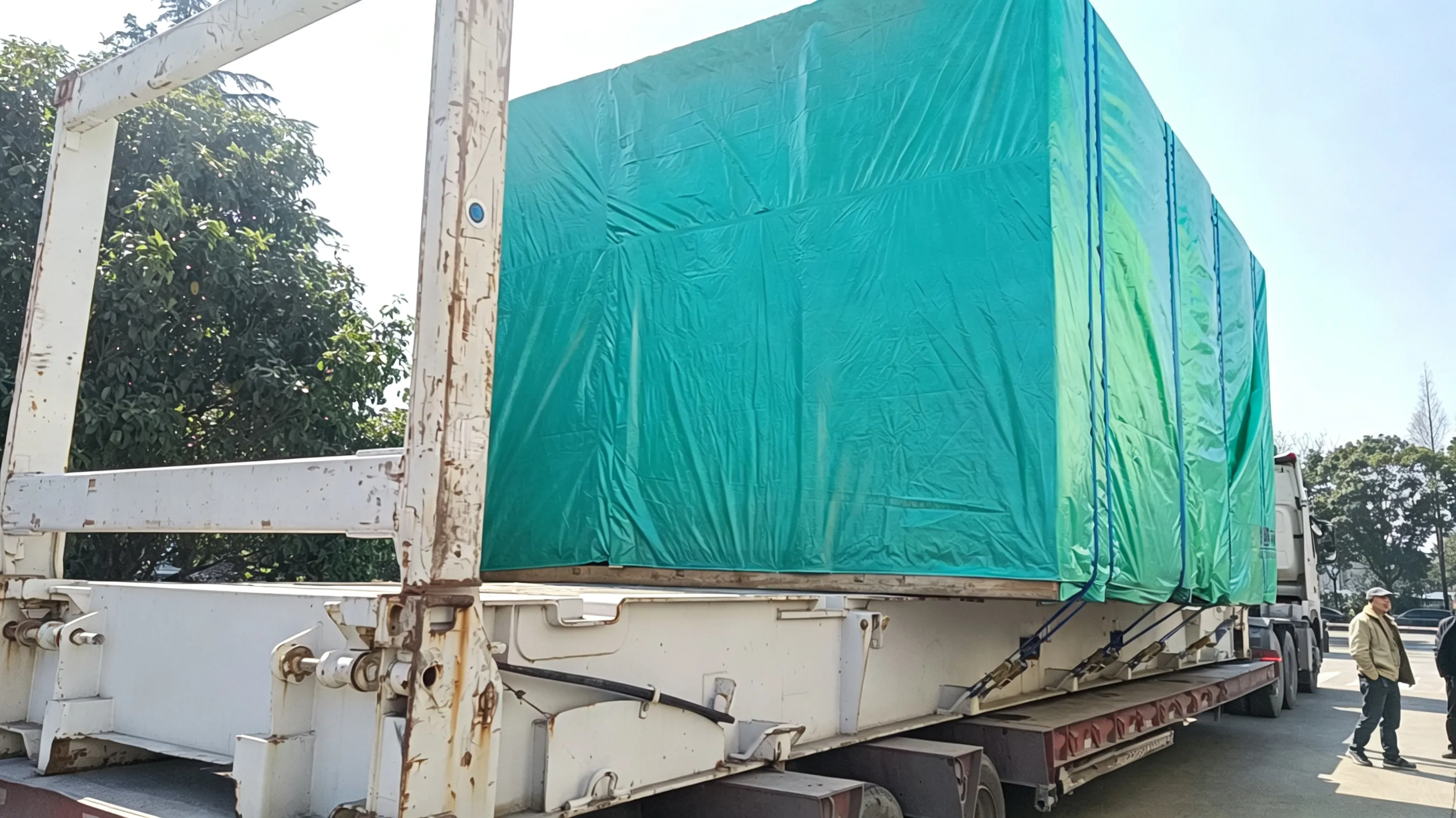
Open Top Container, Flat Rack or Breakbulk Vessel?
Core Selection Indicators: Equipment Height, Width and Weight
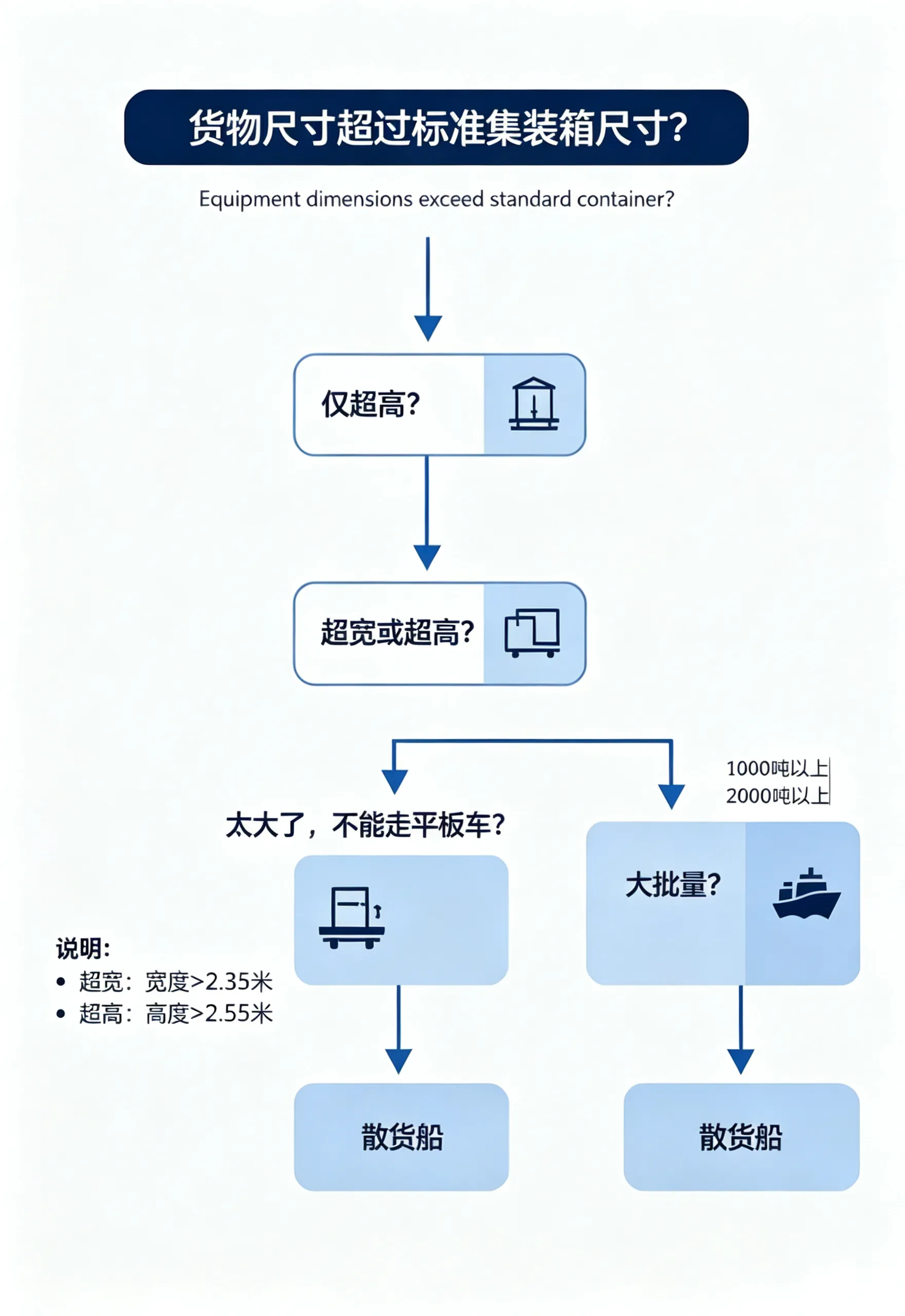
Do not select carriers merely based on ocean freight. Comprehensive consideration shall be given to equipment shape, hoisting conditions, ship schedules, space availability and handling capacity of destination ports.
表格
|
Open Top (OT)Suitable for over height equipment such as transformers, boilers and vertical machines |
Flat Rack (FR)Suitable for over width & over height construction machinery and large units |
Breakbulk VesselSuitable for extra large, overweight or irregularly shaped equipment |
|
Open Top containers have no fixed roof; equipment can be loaded from the top and extend upward, applicable to equipment exceeding standard height but within standard width. The load capacity of a 20ft OT is about 28 tons, and a 40ft OT about 26 tons. Actual carrying capacity shall be subject to the review of carriers and specific routes. |
Flat Racks only have bottom plates and four corner columns without side walls or roofs, allowing equipment to extend beyond the rack from both sides and top. The load capacity of a 20ft FR is about 35 tons, and a 40ft FR about 26 tons. Ocean freight is usually higher than standard containers, and space reservation in advance is required for popular routes. |
Breakbulk vessels are adopted when equipment size or weight exceeds the bearing capacity of Flat Racks, or the shape is too irregular to be fixed. Goods are loaded into holds or placed on decks; ship schedules, loading conditions and destination port resources must be confirmed in advance. |
In the scheme design stage, GOOWELL evaluates the feasibility of the three transportation methods one by one based on equipment 3D dimension drawings, weight data and center of gravity information, compares cost, timeliness and space availability, and provides matched solutions. Transportation selection is not simply choosing the cheapest option, but the one most suitable for equipment and routes.
Lashing & Reinforcement of Bare Shipment Equipment
Bare shipment equipment at sea bears multi directional forces caused by rolling, pitching and heaving of vessels. All lashing schemes are designed following three principles: balanced center of gravity, multi point fixing and redundant protection, and must be submitted to carriers for review.
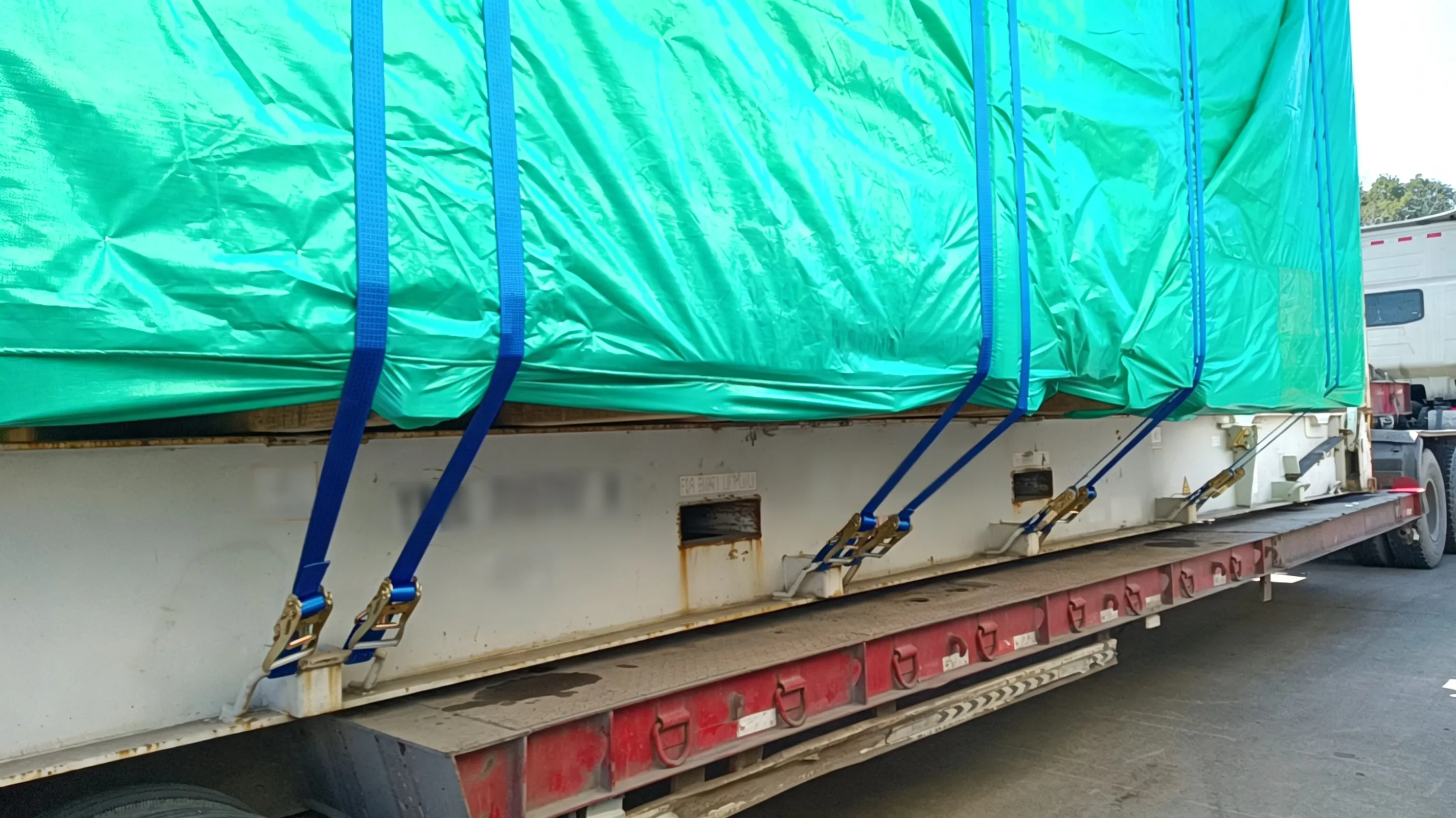
1. Primary Timber Chocking: Wedge hardwood blocks around the bottom of equipment to restrict horizontal displacement. The specification and density of timbers shall be calculated based on equipment weight; heavy equipment requires hardwood with sufficient strength.
2. Steel Band Lashing: Fasten steel lashing bands crosswise over the top of equipment to the fixing points of Flat Racks. The specification, quantity, angle and tension of steel bands are determined according to cargo weight and stress conditions.
3. Auxiliary Lashing Straps: Nylon or polyester ratchet straps are used for auxiliary fixing besides steel bands. Their elasticity can absorb part of transportation vibration to form complementary protection with rigid steel bands.
4. Steel Wire Rope Backup: For extra large, overweight equipment or machinery with irregular center of gravity, additional steel wire ropes are used as redundant protection, connecting reliable lifting lugs of equipment to corner castings or fixing points of Flat Racks.
Equipment shall be placed on Flat Racks with its center of gravity reasonably aligned with the geometric center of the rack. For equipment with offset gravity or irregular shapes, adjust placement angle, add supports or set counterweights to improve stress distribution. After lashing, carriers will review the transportation safety based on size, weight, center of gravity and fixing scheme; unqualified schemes need revision and re submission.
Lashing is more than simple tightening. The angle, tension, fixing point and material specification of every steel band shall have clear design basis and inspection records.
Oversize Transit Permits and Export Customs Declaration Procedures
Step 1: Apply for Inland Oversize Transit Permits
For transit of over width & over height equipment from factories to ports, oversize vehicle transit permits shall be applied to transportation authorities of all provinces and cities along the route. Application materials generally include equipment dimension & weight data, transportation route maps, vehicle information and escort plans. Approval cycle and specific requirements shall follow local competent authorities.
Step 2: Confirm Port Loading Conditions
Flat Rack cargo is generally lifted by port quay cranes; breakbulk equipment may require floating cranes or ship mounted cranes. Verify hoisting capacity, operating radius, lifting lug position and port height limit in advance. Partial disassembly may be needed for some extra large equipment.
Step 3: Prepare Export Customs Declaration Documents
Accurate HS code classification and complete declaration elements are required for bare equipment export. Brand, model, function, application and technical parameters shall be consistent with contracts, invoices, packing lists and technical manuals; confirm export licenses or other regulatory requirements in advance if applicable.
Step 4: Arrange Ocean Shipping and Destination Delivery
After booking space, continuously track loading, transshipment and ocean transportation progress. Confirm hoisting capacity of destination ports, customs clearance documents, local road height & width limits and final door delivery plans beforehand.
The customs team of GOOWELL prepares trade contracts, commercial invoices, packing lists, equipment technical manuals and necessary regulatory certificates in advance, and formulates declaration and inspection coordination plans in line with port requirements to reduce the risk of equipment detention at ports.
Project Case: Shipment of 4.8m Double Oversize Equipment to Indonesia
GOOWELL once undertook a door to door project transporting 4.8 meter high over width & over height equipment from domestic factories to a manufacturing plant on Batam Island, Indonesia. The transportation route covers factory pickup, transit to Shanghai Port, transshipment via a third country port, and final delivery to the factory on Batam Island.
Project Difficulties
Extra large equipment size, complex structure, irregular center of gravity and stress points Multiple transshipment links Height and width restrictions on local roads of Batam Island
Customized Solutions
Our team formulated Flat Rack loading schemes, coordinated professional hoisting operators, conducted pre survey on local roads of Batam Island, and coordinated transshipment terminals, customs clearance and destination delivery links as a whole.
The equipment was delivered safely and on schedule without damage or loss, with smooth customs clearance. Besides this project, GOOWELL has completed landmark logistics projects including full factory relocation of automobile manufacturers, consolidated export of 382 sets of equipment, export of large mechanical equipment to Fiji, as well as machinery export to Tanzania, Algeria, Kenya, Côte d’Ivoire and other countries.
Logistics of heavy equipment tests not only transportation capacity, but also overall project coordination capability.
Common FAQs for Bare Shipment of Over Width & Over Height Equipment
Q: How much higher is the ocean freight of Flat Racks than standard containers? A: Flat Rack freight is generally higher than standard containers. The specific price difference depends on shipping routes, carriers, equipment dimensions and space availability. Space reservation in advance is required for popular routes. Final quotation shall be subject to the review of carriers on the scheme.
Q: Is cargo insurance required for export of over width & over height equipment? A: It is recommended to purchase transportation insurance based on cargo value, transportation routes, loading methods and risk allocation. Insurance application needs to provide proof of equipment value, transportation scheme and lashing reinforcement documents.
Q: How to unload equipment at destination ports? A: It depends on transportation mode and port conditions. Flat Rack cargo is unloaded by port quay cranes; breakbulk equipment may require floating cranes or ship mounted cranes. Unloading schemes shall be confirmed with destination ports in the transportation design stage.
Q: What if carriers reject the submitted lashing reinforcement scheme? A: Revise the lashing points, material specifications, fixing methods or center of gravity layout according to review comments before re submission. Pre conduct force calculation and on site review before submission to reduce repeated revisions.
Q: Are oversize transit permits valid across provinces? A: Permits shall be handled in accordance with specific regulations of each province and city along the transit route. Apply for route specific permits and escort plans in advance; a single permit issued by one region cannot cover the whole cross provincial transit.
Key Reminder
Recheck the final outer contour dimensions after confirming packaging and protection schemes. The thickness of packaging materials including wooden cases, tarpaulins, corner protectors and supports shall all be counted into the maximum overall dimensions.
Bare Shipment Service Capacity of GOOWELL
GOOWELL provides import and export logistics services for over width & over height equipment, precision instruments, complete production lines and various mechanical equipment. We formulate multi modal transportation schemes tailored to equipment dimensions, weight, shape and special requirements.
Our full service scope includes packaging & reinforcement, route survey, professional escort, space booking & loading, export customs clearance, ocean shipping tracking and door delivery at destinations. In terms of shipping resources, we can coordinate Flat Racks, Open Top containers and breakbulk vessel space according to project demands. Our overseas service network covers Southeast Asia, the Middle East, Africa, South America and other regions.
GOOWELL integrates transportation, customs brokerage, loading/unloading and destination delivery into a unified project plan, helping customers reduce risks of equipment detention, damage and delivery delay.
Export of over width & over height equipment is far more than simple space booking and loading. Every link including dimension measurement, transportation mode selection, lashing reinforcement, oversize permits, customs declaration and ocean shipping monitoring requires advance judgment, pre arrangement and full time on site follow up.
Disclaimer
This document sorts out general industry specifications and practical experience for popular science and communication only, and does not constitute specific operational suggestions, commercial commitments, transportation promises, customs declaration suggestions or legal opinions. Equipment load capacity, carrier review standards, oversize transit permit rules, port operations and destination customs clearance requirements may vary by equipment type, shipping route, port and time. All actual operations shall consult professional logistics and customs brokers, and comply with the latest requirements of carriers and competent authorities.
Guide to Bare Shipment of Over Width and Over Height Equipment
How to Conduct Bare Shipment of Over Width & Over Height Equipment
Flat Rack Selection, Lashing Reinforcement and Full Link Operation Key Points
GOOWELL focuses on the import and export of mechanical equipment, providing full link bare shipment services for over width and over height equipment covering scheme design to delivery at destination factories.
Taking a 4.8 meter high equipment as an example: transporting it from domestic factories to factories on Batam Island, Indonesia involves multiple links including dimension measurement, transportation mode selection, lashing reinforcement, oversize transportation permits, port loading and unloading, ocean shipping monitoring, customs clearance and delivery at destination ports. The difficulty of bare shipment does not lie in loading goods onto ships, but whether every pre loading detail is properly handled.
Why Bare Shipment of Over Width & Over Height Equipment Is Complicated
Bare shipment means that the equipment is not loaded into standard containers, but directly fixed on Flat Racks or placed on the deck of breakbulk vessels for transportation. This transportation method is feasible when the equipment width exceeds about 2.35 meters and height exceeds about 2.39 meters, making it unable to fit into standard containers.
Standard containers have fixed internal dimensions: the internal width of a 20ft container is about 2.35m and internal height about 2.39m; the internal length of a 40ft container is about 12m. Once the length, width, height or weight of the equipment exceeds the matching range, special transportation solutions must be re evaluated. For irregularly shaped equipment with protruding parts, measurements must take the maximum outer contour size instead of only the main body size.
1. Dimension Measurement: Length, width, height, weight and center of gravity are the basis of scheme design. Measurement errors may lead to wrong selection of transportation modes, failed lashing schemes or even failure of ship loading.
2. Transportation Mode Selection: Open Top containers are suitable for over height equipment; Flat Racks for over width and over height equipment; breakbulk vessels for extra large equipment whose size or weight exceeds the bearing capacity of Flat Racks.
3. Lashing Reinforcement: Equipment needs to withstand rolling, pitching and heaving of ships during ocean transportation. Lashing schemes must pass force calculation and carrier review.
4. Full Link Compliance: Coordinate oversize transportation permits for transit from factories to ports, port hoisting conditions, export customs declaration, ocean shipping monitoring and destination road survey before loading on board.
Open Top Container, Flat Rack or Breakbulk Vessel?
Core Selection Indicators: Equipment Height, Width and Weight
Do not select carriers merely based on ocean freight. Comprehensive consideration shall be given to equipment shape, hoisting conditions, ship schedules, space availability and handling capacity of destination ports.
表格
|
Open Top (OT)Suitable for over height equipment such as transformers, boilers and vertical machines |
Flat Rack (FR)Suitable for over width & over height construction machinery and large units |
Breakbulk VesselSuitable for extra large, overweight or irregularly shaped equipment |
|
Open Top containers have no fixed roof; equipment can be loaded from the top and extend upward, applicable to equipment exceeding standard height but within standard width. The load capacity of a 20ft OT is about 28 tons, and a 40ft OT about 26 tons. Actual carrying capacity shall be subject to the review of carriers and specific routes. |
Flat Racks only have bottom plates and four corner columns without side walls or roofs, allowing equipment to extend beyond the rack from both sides and top. The load capacity of a 20ft FR is about 35 tons, and a 40ft FR about 26 tons. Ocean freight is usually higher than standard containers, and space reservation in advance is required for popular routes. |
Breakbulk vessels are adopted when equipment size or weight exceeds the bearing capacity of Flat Racks, or the shape is too irregular to be fixed. Goods are loaded into holds or placed on decks; ship schedules, loading conditions and destination port resources must be confirmed in advance. |
In the scheme design stage, GOOWELL evaluates the feasibility of the three transportation methods one by one based on equipment 3D dimension drawings, weight data and center of gravity information, compares cost, timeliness and space availability, and provides matched solutions. Transportation selection is not simply choosing the cheapest option, but the one most suitable for equipment and routes.
Lashing & Reinforcement of Bare Shipment Equipment
Bare shipment equipment at sea bears multi directional forces caused by rolling, pitching and heaving of vessels. All lashing schemes are designed following three principles: balanced center of gravity, multi point fixing and redundant protection, and must be submitted to carriers for review.
1. Primary Timber Chocking: Wedge hardwood blocks around the bottom of equipment to restrict horizontal displacement. The specification and density of timbers shall be calculated based on equipment weight; heavy equipment requires hardwood with sufficient strength.
2. Steel Band Lashing: Fasten steel lashing bands crosswise over the top of equipment to the fixing points of Flat Racks. The specification, quantity, angle and tension of steel bands are determined according to cargo weight and stress conditions.
3. Auxiliary Lashing Straps: Nylon or polyester ratchet straps are used for auxiliary fixing besides steel bands. Their elasticity can absorb part of transportation vibration to form complementary protection with rigid steel bands.
4. Steel Wire Rope Backup: For extra large, overweight equipment or machinery with irregular center of gravity, additional steel wire ropes are used as redundant protection, connecting reliable lifting lugs of equipment to corner castings or fixing points of Flat Racks.
Equipment shall be placed on Flat Racks with its center of gravity reasonably aligned with the geometric center of the rack. For equipment with offset gravity or irregular shapes, adjust placement angle, add supports or set counterweights to improve stress distribution. After lashing, carriers will review the transportation safety based on size, weight, center of gravity and fixing scheme; unqualified schemes need revision and re submission.
Lashing is more than simple tightening. The angle, tension, fixing point and material specification of every steel band shall have clear design basis and inspection records.
Oversize Transit Permits and Export Customs Declaration Procedures
Step 1: Apply for Inland Oversize Transit Permits
For transit of over width & over height equipment from factories to ports, oversize vehicle transit permits shall be applied to transportation authorities of all provinces and cities along the route. Application materials generally include equipment dimension & weight data, transportation route maps, vehicle information and escort plans. Approval cycle and specific requirements shall follow local competent authorities.
Step 2: Confirm Port Loading Conditions
Flat Rack cargo is generally lifted by port quay cranes; breakbulk equipment may require floating cranes or ship mounted cranes. Verify hoisting capacity, operating radius, lifting lug position and port height limit in advance. Partial disassembly may be needed for some extra large equipment.
Step 3: Prepare Export Customs Declaration Documents
Accurate HS code classification and complete declaration elements are required for bare equipment export. Brand, model, function, application and technical parameters shall be consistent with contracts, invoices, packing lists and technical manuals; confirm export licenses or other regulatory requirements in advance if applicable.
Step 4: Arrange Ocean Shipping and Destination Delivery
After booking space, continuously track loading, transshipment and ocean transportation progress. Confirm hoisting capacity of destination ports, customs clearance documents, local road height & width limits and final door delivery plans beforehand.
The customs team of GOOWELL prepares trade contracts, commercial invoices, packing lists, equipment technical manuals and necessary regulatory certificates in advance, and formulates declaration and inspection coordination plans in line with port requirements to reduce the risk of equipment detention at ports.
Project Case: Shipment of 4.8m Double Oversize Equipment to Indonesia
GOOWELL once undertook a door to door project transporting 4.8 meter high over width & over height equipment from domestic factories to a manufacturing plant on Batam Island, Indonesia. The transportation route covers factory pickup, transit to Shanghai Port, transshipment via a third country port, and final delivery to the factory on Batam Island.
Project Difficulties
Extra large equipment size, complex structure, irregular center of gravity and stress points Multiple transshipment links Height and width restrictions on local roads of Batam Island
Customized Solutions
Our team formulated Flat Rack loading schemes, coordinated professional hoisting operators, conducted pre survey on local roads of Batam Island, and coordinated transshipment terminals, customs clearance and destination delivery links as a whole.
The equipment was delivered safely and on schedule without damage or loss, with smooth customs clearance. Besides this project, GOOWELL has completed landmark logistics projects including full factory relocation of automobile manufacturers, consolidated export of 382 sets of equipment, export of large mechanical equipment to Fiji, as well as machinery export to Tanzania, Algeria, Kenya, Côte d’Ivoire and other countries.
Logistics of heavy equipment tests not only transportation capacity, but also overall project coordination capability.
Common FAQs for Bare Shipment of Over Width & Over Height Equipment
Q: How much higher is the ocean freight of Flat Racks than standard containers? A: Flat Rack freight is generally higher than standard containers. The specific price difference depends on shipping routes, carriers, equipment dimensions and space availability. Space reservation in advance is required for popular routes. Final quotation shall be subject to the review of carriers on the scheme.
Q: Is cargo insurance required for export of over width & over height equipment? A: It is recommended to purchase transportation insurance based on cargo value, transportation routes, loading methods and risk allocation. Insurance application needs to provide proof of equipment value, transportation scheme and lashing reinforcement documents.
Q: How to unload equipment at destination ports? A: It depends on transportation mode and port conditions. Flat Rack cargo is unloaded by port quay cranes; breakbulk equipment may require floating cranes or ship mounted cranes. Unloading schemes shall be confirmed with destination ports in the transportation design stage.
Q: What if carriers reject the submitted lashing reinforcement scheme? A: Revise the lashing points, material specifications, fixing methods or center of gravity layout according to review comments before re submission. Pre conduct force calculation and on site review before submission to reduce repeated revisions.
Q: Are oversize transit permits valid across provinces? A: Permits shall be handled in accordance with specific regulations of each province and city along the transit route. Apply for route specific permits and escort plans in advance; a single permit issued by one region cannot cover the whole cross provincial transit.
Key Reminder
Recheck the final outer contour dimensions after confirming packaging and protection schemes. The thickness of packaging materials including wooden cases, tarpaulins, corner protectors and supports shall all be counted into the maximum overall dimensions.
Bare Shipment Service Capacity of GOOWELL
GOOWELL provides import and export logistics services for over width & over height equipment, precision instruments, complete production lines and various mechanical equipment. We formulate multi modal transportation schemes tailored to equipment dimensions, weight, shape and special requirements.
Our full service scope includes packaging & reinforcement, route survey, professional escort, space booking & loading, export customs clearance, ocean shipping tracking and door delivery at destinations. In terms of shipping resources, we can coordinate Flat Racks, Open Top containers and breakbulk vessel space according to project demands. Our overseas service network covers Southeast Asia, the Middle East, Africa, South America and other regions.
GOOWELL integrates transportation, customs brokerage, loading/unloading and destination delivery into a unified project plan, helping customers reduce risks of equipment detention, damage and delivery delay.
Export of over width & over height equipment is far more than simple space booking and loading. Every link including dimension measurement, transportation mode selection, lashing reinforcement, oversize permits, customs declaration and ocean shipping monitoring requires advance judgment, pre arrangement and full time on site follow up.
Disclaimer
This document sorts out general industry specifications and practical experience for popular science and communication only, and does not constitute specific operational suggestions, commercial commitments, transportation promises, customs declaration suggestions or legal opinions. Equipment load capacity, carrier review standards, oversize transit permit rules, port operations and destination customs clearance requirements may vary by equipment type, shipping route, port and time. All actual operations shall consult professional logistics and customs brokers, and comply with the latest requirements of carriers and competent authorities.
Previous:Import of assembly line equipment
ABOUT GOOWELL
Ningbo Goowell International Logistics Co., Ltd. has always adhered to the vision of providing customers with safe and convenient services since its establishment, and has established cooperation with many foreign companies, central state-owned enterprises, listed companies and well-known domestic enterprises.